Just came across lots of brilliant information on the flocycling website (they make aero wheels). Have a look at their blogs here: http://flocycling.blogspot.co.uk/
From these blogs I have reproduced the following key information! thanks Flo Cycling!
Q1. What shape is best for bike tubes / spokes /bars (assuming no compromise in weight bearing)
Q2. What is the effect of speed on drag from a bike wheel (aero vs non-aero)
Q3. What is the effect of side wind (yaw into head wind)
Q4. What is the effect of wheels on speed over a long flat time trial / iron man
Q5. What is the effect of wheels on speed over a long flatish time trial / iron man
Q6. What is the effect of wheels on speed over a longclimbing stage
Time with "Un-Aero" Wheels Light Training Wheels (1100 grams) : 1:09:46
Time with Aero Wheels FLO 90/DISC (2259 grams) : 1:10:09
Why do we have to make do with heavy TT bikes? We know that standard line is that weight doesn'tt make much of a difference in TT. Sorry this is pretty much mis-information. Except for downhill and really flat courses bike: weight is usually important. v important if its uphill (as is rider weight). Indeed dropping 10kg will save about 1min of a hilly 25mile timetrial which has an 2000m (0.5% ave) of hills see this link. There is added benefit of a light rider because a light rider is also an aero rider!
Therefore, we have been trying to find the lightest TT bike and this could be it (with slight modification)!
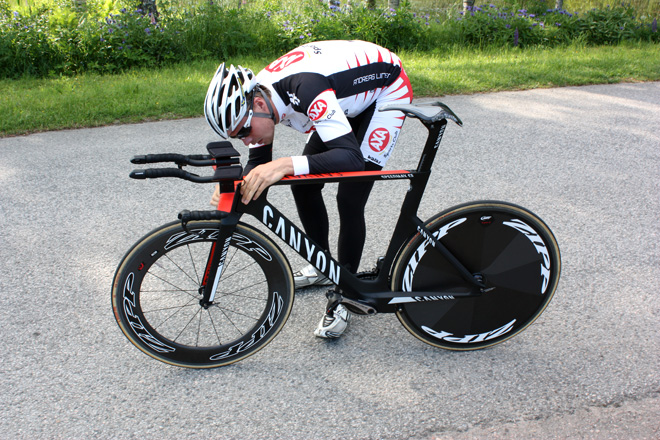
Andreas's linden Canyon Speedmax
see http://andreaslinden.se/2013/07/04/canyon-speedmax-cf-2013/
In fact his current Zipp rear disc weighs 1175g which is not bad but the "DASH GRETCHEN" read disc is 770g
and similarly the Lightweight-autobahn-rear-disc-wheel is only 780g; so if he fitted that it would be 6.9kg! (but ok it would cost at extra 2500 euros!!)
.......and I just found a pic where someone has done just that
The fastest unassisted human powered bike world record was
82.8Mph by Sam Whittingham set in 2009. Barbara Buatois managed 75.7Mph
in 2010. In 2011, a college team from TU-Delft in the Netherlands
became the 2nd fastest all-time with a rider, Sebastian Bowier:
80.5Mph. These bike require serious gearing
However you can go faster with assistance. Way back in 1979 Jean Claude Rude was an ambitious man and the French
cyclist wanted to break the world bicycle speed record. In order to
become the world’s fastest on bike, he had to go faster than his fellow
countryman José Meiffret who had set the record at an impressive
204.7km/h (127.2mph) in 1962. This amazing speed was achieved on the
German Autobahn, presumably closed for other traffic, near Freiburg where Meiffret was riding in the slipstream of a Mercedes-Benz 300 SL. But at a speed of 160km/h (100mph) when
suddenly Jean Claude’s rear tire exploded and was torn from the wheel.
Forward to 2013, Guy Martin did 110mph using motor pacing (sheltering behind a truck)!
The motorcycle racer and lorry mechanic
from Grimsby was filmed by Channel 4 last year, as he attacked the
record of 110mph set by Dave Le Grys on the unopened M42 motorway in
1986.
With no unopened motorways available, Martin opted for Pendine Sands
in South Wales, a seven-mile stretch of beach with a history of record
breaking: it was first used in 1924 by Malcolm Campbell to reach 146mph
in his Bluebird. But pedalling a pushbike on sand at over 100mph is
hairier than Martin’s cheeks.
Using a similar compound gear system to
Dave Le Grys’s original 1985 bike, built by Cliff Shrubb, Hope supplied
custom cranks, bottom brackets and two 60-tooth chainrings. With a 16t
sprocket on the seat tube and 15t on the rear wheel, the wheel turned 15
times for every pedal revolution. At 112mph, Martin’s cadence was
97rpm, and the wheel was spinning at 1,460r
Olympic Cyclist and IRONMAN triathlon winner, John Howard set a 152.2
Miles per Hour speed record at the Bonneville Salt Flats near Wendover, Utah on
July 20, 1985. He is drafting in the wake of a 500 Horsepower Streamliner. This type of
human powered record is called motor pacing. The pace vehicle was
modified by adding a large tail fairing to the 337 MPH record holding Vesco Streamliner.
The fairing keeps the wind off John and reduces the aerodynamic drag he is pedaling
against to near nothing.
This type of record was invented by Charles
"Mile-a-Minute Murphy" who drafted a train to set a 60 MPH record at
the turn of the century. A mile of plywood sheets was attached to the railroad ties, so
Charles would have a smooth surface. He had to be lifted onto the train just before they
ran out of the plywood surface!
The previous record holder at 138.8 MPH set in
1973 was physician, Dr. Allan Abbott, a cycling enthusiast and motorcycle racer.
What about powered bikes? Now this is crazy. Frenchman Francois Gissy hit 285 km/h (177 mph) on a rocket-powered bicycle.
Now, at the Circuit Paul Ricard in the South of France, he's knocked
his own world record out of the park. Dialing in a massive 4.5 kN of
thrust, which generates roughly the equivalent of 560 horsepower, Gissy
took his rickety-looking rocket bike up to a monstrous 333 km/h (207
mph), hitting top speed in just 4.8 seconds and generating about 1.96 Gs
worth of acceleration.
OMG! £215 for a seatpost that’s ridiculous! Yes it is....but it could be worth it and your rear could thank you for it!!
I saw this in the press when it was launched by Canyon in 2012 as a suspension seatpost for the road and I was intrigued. £200 was too much but I bought one off ebay for less than £100 in great condition (seatposts don’t generally deteriorate second hand).
Suspension seatposts are usually big and heavy for MTB and not at all suitable for light road bikes. So if someone can make a 229g road version that would be very interesting indeed.
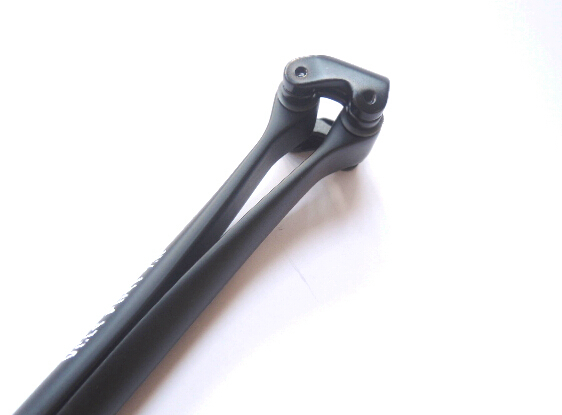
The VCLS ( Vertical Comfort Lateral Stiffness) flexes and take the sting out of harsh roads, cobbles, potholes and any poor surfaces. The post is split into two halves like two flat springs, which operate parallel to one another up to 2.5cm yet the Flip Head ensures the saddle stays horizontal.
I swapped a titanium post for this today and did a short 10km ride on bumpy roads. The titanium post has tiny amount of give may 5mm but its not a setback / layback design so it was always pretty jarring. The effect of the VCLS was immediate. It smooths out a lot of bumps really well. Not so much so that the ride feels spongy but enough so that you rear feels cushioned (in fact my hands were much more jarred). You actually cant directly feel the movement but its definitely there. The setback curve of the designs adds more to the effect, and actually improved by riding position relative to the cranks. For weightweenees there may be a weight penalty of 100g or so compared to tune / ax-lightness etc. but these carbon posts are also v jarring. Who wants thousands or millions of bumbs transmitted up your spine year after year. No, this is one area where the cost and the weight are definitely worth it!
Why so expensive? It is overpriced as RRP but its apparently made from crushed basalt (rock) which is then melted down and extruded into very fine fibres before being made into a seatpost which compared with titanium, basalt fibre has better elasticity, and the resin used in construction also gives a higher level of damping.
Any restrictions? Yes v limited sizes: 27.2mm diameter and 300mm length post only. So it wont fit a lot of bikes without a shim and I am not sure if a shim will be ok with this design. Also I think you need to swap heads to fit carbon rails. Also clamping it into the frame securely proved a problem because the parallel design resists the seatpost collar. However this video gives advice on fitting.
Overall: pretty amazing design which looks simple and is effective. Recommended and ask yourself....what is protection and care of your rear end worth to you!! ;)
Strava is king right now. King of its own GPS tracking mountain. Its an amazing successful running / cycling app which logs your progress and uploads it to the cloud. The really clever bit is that it compares you to everyone else who has ever taken that route (and logged it) and if that doesn't appeal then it compares vs your previous times.
It seems that strava has about 8.2 million sign ups and about 1.2
million monthly active users.[1]
photo(c) bikeradar.com
Background
Strava was created by Harvard rowers Michael Horvath and Mark Gainey. Strava uses GPS tracking in your smart phone or watch and lets lets you upload them as soon as you finish. The whole process takes only about a minute. More than 4.5
million segments have been created globally 3/4 cycling and 1/4 running times. Its accurate too, it even deletes portions where you stop for more than 10seconds, there is a lot of processing going on behind the scenes to tie up sometimes flaky GPS signals with what you actually did. Have a look at this link for in depth strava GPS musings of impossibly fast times.
Now here is where it gets interesting. You can bag a badge for a quick time (maybe they should do super slow badges too ;) ). The
best time claims a KOM or QOM (King or Queen of the Mountain), and the
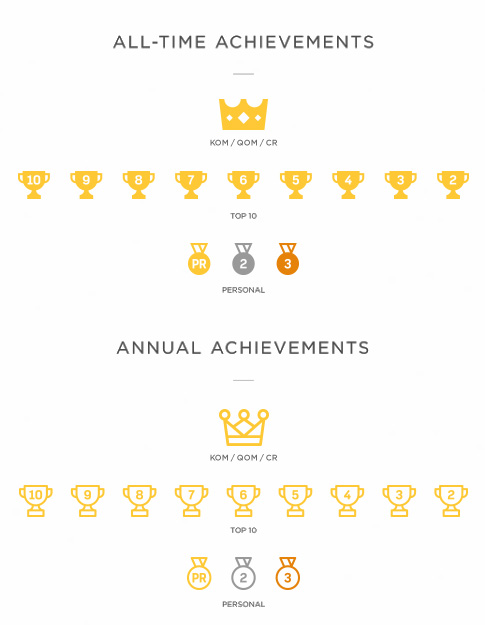
site also tracks each top 10s for all time and top 10 for this year. Finally it logs top 3 personal times (for the year and for all time). And it does this for every single segment (roughly 1km+ stretches of your route). It all looks like this:
Achievements
Now you might ask so what? I started using strava in May 2015. I signed up for the free premium trial but there is no need to do this, its still awesome in its free format. I have logged 71 rides and 1 run. I can attest it seriously addictive. I wouldn't dream of going for a ride without strava now, unless its an intentionally slow nip to the shops!
Now I am not a particularly good cyclist, powertap has my 30min PB at only 250w. A pro cyclist is in their recovery zone at 300-350watts and they can cycle 250w with one leg! So not so good then. Neverthless like anyone I can go hell for leather for short periods! Using this and other tactics I have got about 5 KOMs.....ok on unpopular super quiet routes!! But the bottom line is its fun and it keeps your cycling and its a great target for improvement. This is one app which makes you think, technology is amazing these days!
Now for the downside. Some people go crazy. Some have even been killed racing for KoMs. So much so Strava has been sued, and has adapted its app. See this BBC link for an interesting description.
There is a lot more to strava on a personal level. Of course you have your route, speed, distance but you also have watts (estimated and not accurate btw....its about 20% under reporting compared to a watt meter like powertap) and energy used. Speaking of energy used...I went flat out for 30mins and used 467kj of energy (111kcal). Sadly that is about 200mls of orange juice which i drank in 10 seconds of returning to the house! Here is a screenshot of the ride:
Strava knows your entire history (if uploaded) so it can act as a useful training log.
There are also a lot of pro riders on strava link here, with unassailable times and huge rides and some riding on annonymously too.
The bottom line? Strava is free, its accurate, its fun, its motivational. Love it!
In this years Tour there was an explosion of data. First Chris Froome's personal data leaked and then officially released by Team Sky. Then DimensionData collected a huge amount and released a lot on its website here http://www.dimensiondata.com/Global/Documents/Race%20in%20Review.pdf
But of particular interest, Strava the cycling app was worn by South African rider Jacques Van Rensburg who finished 51st out of 160, after 3,403.6 km (2115 miles) as recorded on Strava. His average speed over that distance was 38.39km/h (23.85 miles) with an average power output of 208 watts. His average cadence was 86 and he climbed an 45,134 metres!
Now consider that to do this incredible ride over 3 weeks he used up 74,983 calories (estimated) or the equivalent of 291 Big Macs! Finishing the tour is an amazing acheivement on its own, give anyone would have to be 1. superfit 2. relentless 3. prepared to burn 75,000 calories based on human effort alone.
By coincidence thats almost exactly the same as Morgan Spurlock, who ate only McDonalds for 30days in 2003
As a result he gained 11.1 kg (24 lb), a 13% body mass increase, increased hischolesterolto 230 mg/dL, and experiencedmood swings,sexual dysfunction, and fat accumulation in his liver. It took Spurlock fourteen months to lose the weight gained from his experiment using avegandiet supervised by his then-girlfriend (now ex-wife), a chef who specializes in gourmet vegan dishes see https://en.wikipedia.org/wiki/Super_Size_Me
After the film sales of the famous burger chain decreased by $42 million in the USA. After that the fast food chain made some drastic changes. They introduced more nutritional items such as salads and fruit snacks while taking out the super-size option off its menu. Of course 95% still eat unhealthy at McDonalds.